
Navigating AI Together: A Guide for Families
In our schools, we believe that technology should serve as a tool for learning, not a replacement for thinking. As Artificial Intelligence (AI) becomes more common, our goal is to “label reality” and provide students with clear boundaries so they know when to flex their own “mental muscles” and when it is appropriate to use digital assistance. One of the ways your child’s teacher (Gr. 6-12) will do this is to use the Zero to Infinity Framework.
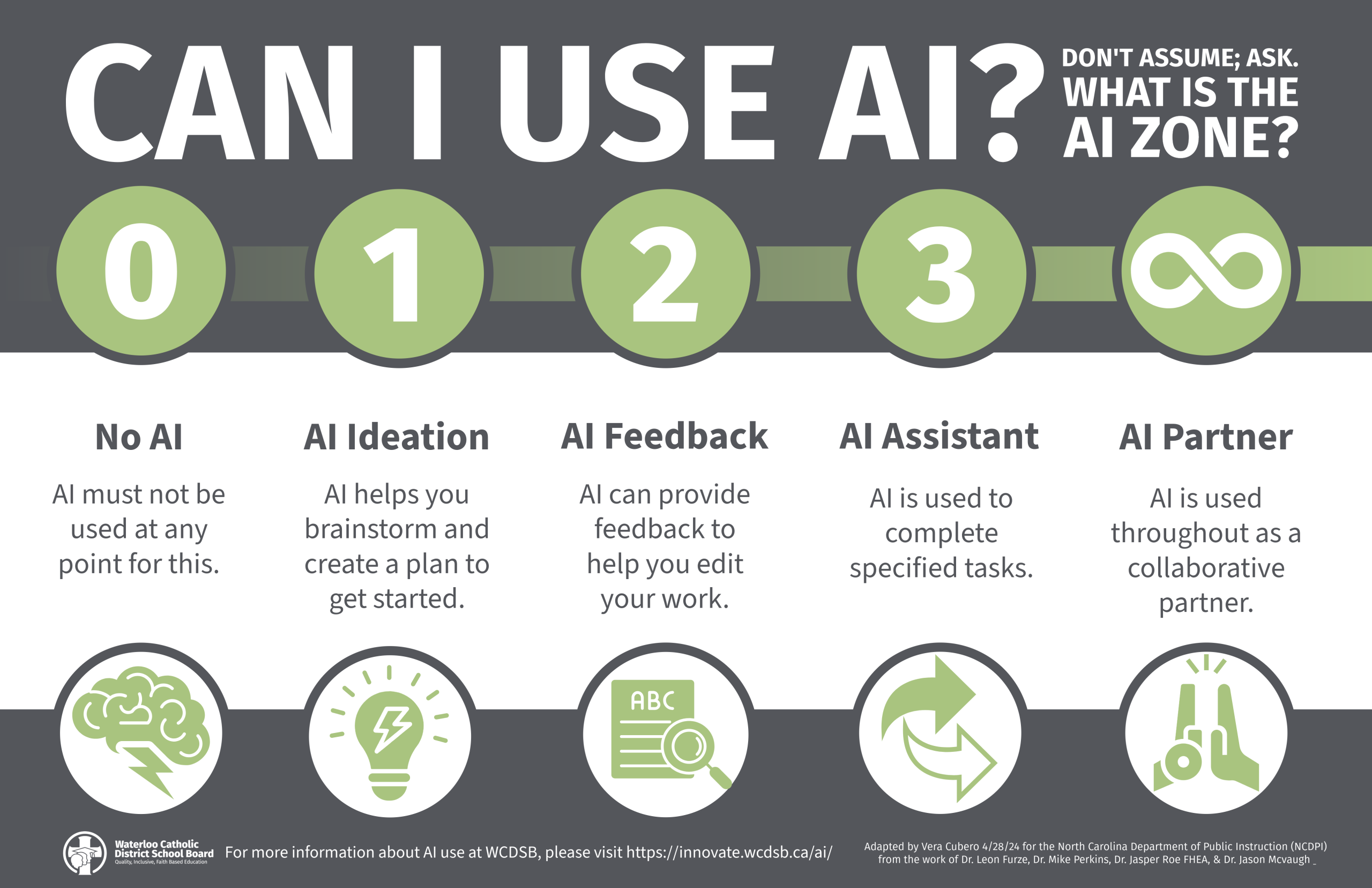
Why “Zero to Infinity”?
Our choice of this framework is rooted in our commitment to the Ontario Catholic School Graduate Expectations (OCSGE). We want our students to be “Discerning Believers” who can navigate the digital world with a critical and moral lens.
1. Honoring our God-Given Potential
Catholic Social Teaching emphasizes the “Dignity of the Human Person.” We believe that true fulfillment comes from developing the talents God gave us.
-
The Intent: Different tasks have different goals. Sometimes, the goal is to master a foundational skill or to develop our own “inner voice.” Other times, the goal is to learn how to lead and direct complex tools.
-
The Levels: Level 0 ensures we are nurturing the unique human intellect that AI can never replace. Levels 1-3 teach us to use technology as a “navigator” while we remain the “pilot” of our own moral journey.
2. A Commitment to Truth and Integrity
As a community of faith, we are called to walk in the light of truth.
-
Labeling Reality: We recognize that AI is present in our students’ lives. By “labeling reality” with specific levels, we remove the temptation of the “grey area.”
-
The Transparency Promise: This is more than a rule; it is a commitment to honesty. When a student acknowledges how they used a tool, they are practicing the virtue of integrity by showing respect for their own work and the work of others.
3. Stewardship and the Common Good
Catholic Social Teaching calls us to be “Stewards of Creation.” Using AI isn’t a neutral act; it has a footprint.
-
Mindful Consumption: We teach students that AI requires energy and water resources. We encourage them to ask: “Is using AI for this task a responsible use of our common home?”
-
Ethical Awareness: We explore the ethics of AI, including how it was trained on the work of real people and the biases it may contain. We challenge students to be “Self-Directed Learners” who verify information and seek out justice and truth.
The Transparency Promise: A Foundation of Trust
Our framework relies on a mutual promise that mirrors our Gospel values:
-
The Teacher promises to provide clear boundaries and “label the reality” of every task.
-
The Student promises to honor those boundaries and be transparent about their process.
-
The Result is a community where technology is used to enhance our humanity, not diminish it.
How You Can Support at Home
Our partnership between home, school, and parish is vital. You can help your child navigate this digital frontier through the lens of faith:
-
Discuss the “Why”: Ask your child, “Does using this tool today help you learn a new skill, or is it doing the thinking for you?”
-
Promote Integrity: Remind them that their value doesn’t come from the grade they receive, but from the honesty and effort they put into their work as a child of God.
-
Model Stewardship: Encourage them to use technology intentionally rather than impulsively, reflecting on its impact on their own well-being and the environment.