
Supported by Research
The Thinking Classroom framework was developed by research Dr. Peter Liljedahl of Simon Fraser University. Our aim is to connect educators with research-based pedagogical moves that are proven to increase student achievement and engagement, to complement our current teaching practices to transform teaching and learning in our schools. While this research was initially done to improve learning in mathematics classrooms from K-12, all subjects across the WCDSB have been using these pedagogical moves with success.
You will find some of the research below related to the Thinking Classroom framework. For more details, contact the innovation team to obtain a copy of Peter’s book, Building Thinking Classrooms in Mathematics, Grades K-12.
Motivation Behind the Thinking Classroom
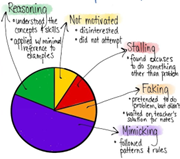 Peter Liljedahl researched traditional classrooms in BC. He observed 40 different classes (grades K – 12) in 40 different schools. The research showed that very few students, less than 25%, were actively thinking about the tasks they were given. The most commonly observed behaviour was mimicking – where students were able to complete an activity, but needed to reference a worked example repeatedly in order to get to a solution. While students were able to answer a similar question by mimicking, since they had not developed their own deep understanding of the activity, they were not able to answer questions that were different from the worked example. Recognizing that mimicking is not learning and that thinking must be the precursor to learning, Peter conducted an action research project to find instructional moves that encouraged student thinking. This research led to the 14 practices of the Thinking Classroom.
“In a typical one-hour lesson, 75%-85% of the students exhibited non-thinking behaviours for 100% of the time. The rest of the students exhibited non-thinking behaviours for all but 8-12 minutes of the time (p.11).”
Comparing Different Working Surfaces
Liljedahl looked at different types of surfaces that students could work on: notebooks, whiteboards, chart paper, etc. His team tracked the effectiveness of each of these surfaces by looking at things like how long it took students to get started on a task, how long they were on task, and how much participation there was. Vertical whiteboards scored the best in every category.
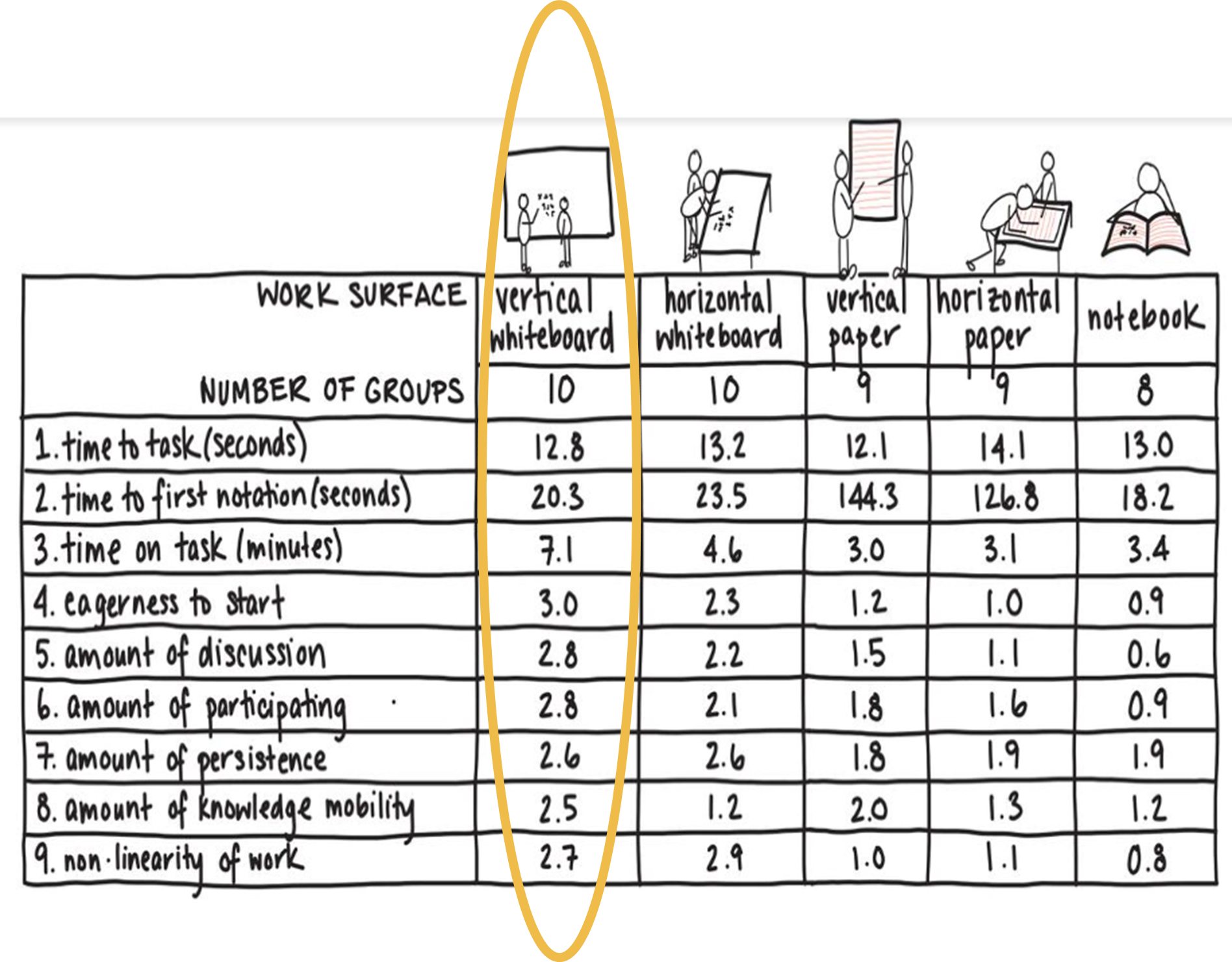
* Behaviour markers 4 – 9 were scored on a scale of 0 (none) to 3 (lots).